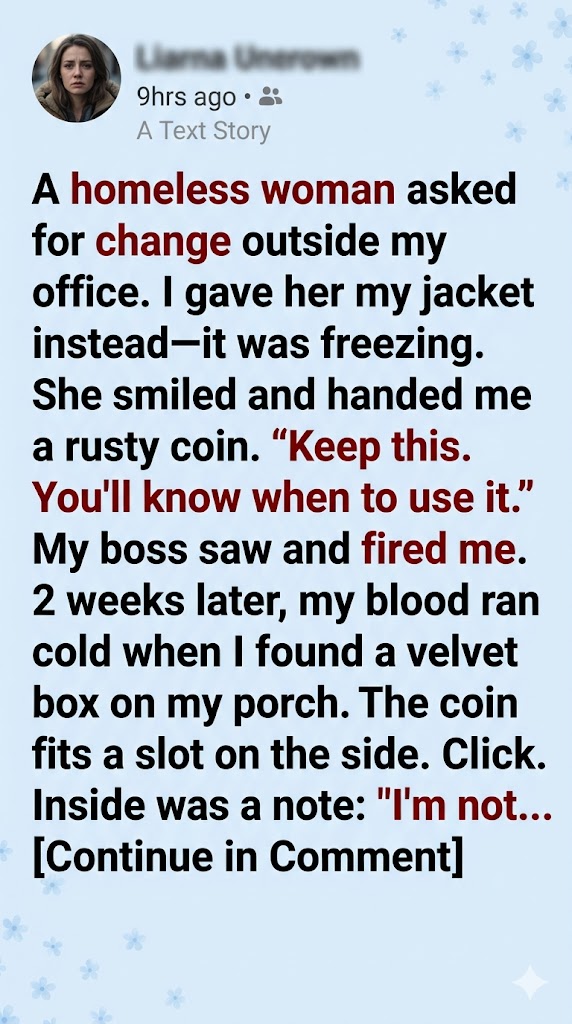
The woman sat curled against the marble wall outside our office building like she was trying to disappear into it.
People passed her constantly without slowing down.
Expensive shoes.
Coffee cups.
Phone calls.
Perfume and impatience moving through Manhattan like a river that never stopped flowing long enough to notice who got left behind.
At first, I almost walked past her too.
Honestly, that’s the part that still haunts me most.
Not what happened afterward.
The fact that I almost became just another person who looked away.
My name is Daniel Mercer, and two weeks before my life changed completely, I was thirty-four years old, overworked, underpaid, and surviving almost entirely on routine.
Wake up.
Subway.
Finance office.
Twelve-hour workdays.
Microwave dinners.
Repeat.
The only thing impressive about my life back then was how efficiently I managed to feel invisible while working inside one of the busiest financial districts in New York.
That Tuesday evening was brutally cold.
For illustration purposes only
The kind of cold that makes your teeth ache the second wind touches your face. I stepped out of our office building adjusting my scarf tighter around my neck while mentally calculating how much money remained in my account until payday.
Then I heard her voice.
“Spare some change?”
Soft.
Almost apologetic.
Not aggressive the way people expect homelessness to sound.
I turned automatically.
She looked somewhere in her late fifties or early sixties, though exhaustion had a way of making age impossible to judge accurately. Gray streaks cut through dark hair tangled beneath a thin knit cap. Her sweater looked far too light for weather like that.
But her eyes…
Her eyes were strangely calm.
Observant.
Like she wasn’t begging so much as quietly studying the world passing her by.
I reached into my coat pocket instinctively.
Nothing.
No cash.
“I’m sorry,” I said awkwardly.
Most people would’ve kept walking after that.
Honestly, I probably should have too.
Instead, I paused.
The wind hit us hard enough to make her shoulders tremble visibly.
And suddenly I became painfully aware of how warm my own coat felt.
Without really thinking it through, I slipped it off.
“You should take this.”
She blinked up at me in surprise.
“No,” she said immediately. “I couldn’t.”
“You can,” I insisted. “I’ve still got my scarf. I’m not going to freeze.”
For a long second, she just stared at me.
Then slowly, carefully, she accepted the coat.
Her fingers brushed mine.
Ice cold.
And despite everything about her appearance, despite the worn clothes and tired posture, something about the way she carried herself still felt oddly… dignified.
Like this situation was temporary.
Or chosen.
Then she pressed something into my palm.
A coin.
Old.
Rust-colored.
Heavier than expected.
“Keep this,” she said quietly.
I frowned.
“I think you need it more than I do.”
She smiled faintly.
“No. You’ll know when to use it.”
Before I could ask what that meant, the glass doors behind me burst open.
“Daniel!”
My stomach dropped instantly.
Mr. Harlan.
My boss.
Tall.
Perfectly tailored coat.
The kind of man who looked expensive even standing still.
He stared at the woman wearing my jacket like she personally offended him.
Then his eyes snapped toward me.
For illustration purposes only
“Are you serious right now?”
I straightened awkwardly.
“Sir, I was just helping—”
“We work in finance,” he interrupted sharply. “Not social services.”
People near the entrance started slowing down to watch.
Heat crawled up my neck immediately.
“She was freezing,” I said quietly.
Mr. Harlan laughed once.
Cold.
Disgusted.
“And now clients get to walk past this spectacle connected to our company.”
My chest tightened.
“Sir—”
“Clear out your desk tomorrow.”
The words hit harder than I expected.
“What?”
“You heard me.”
For one horrible second, I thought he might be joking.
Then I saw the complete lack of emotion in his face.
“You’re firing me?”
“I’m removing a liability.”
Behind me, the woman remained completely silent.
Mr. Harlan adjusted his cuffs calmly.
“People in our field need judgment, Daniel.”
Then he walked away.
Just like that.
No discussion.
No warning.
Twelve years at the company erased in under thirty seconds because I gave away a coat.
I stood frozen outside the building clutching the coin so tightly the edges dug painfully into my skin.
“I’m sorry,” the woman said quietly.
I laughed bitterly.
“Not really your fault.”
The wind cut through my sweater immediately.
Suddenly I understood exactly how cold she must’ve been before.
“You knew exactly what you were doing,” she said softly.
I looked up.
“What?”
But she was already pulling the coat tighter around herself while staring toward the city lights.
Like the conversation was over.
The next two weeks became the worst stretch of my adult life.
Job applications disappeared into silence.
Savings vanished faster than I thought possible.
I stopped sleeping properly around day six.
By day ten, panic followed me everywhere.
How long before rent became impossible?
How long before I lost the apartment too?
One night I actually dug through kitchen drawers looking for loose change to buy groceries.
That was when I found the coin again.
I almost threw it away.
But something stopped me.
Maybe pride.
Maybe curiosity.
Maybe the strange certainty in the woman’s eyes that night outside the office building.
So instead, I dropped it into my desk drawer and forgot about it again.
Then, fourteen days after losing my job, I opened my apartment door and found the velvet box waiting outside.
Black.
Elegant.
No address.
No note.
Just sitting there like it had appeared from nowhere.
My pulse quickened immediately.
Inside the apartment, I placed it carefully on the coffee table.
That was when I noticed the slot.
Small.
Coin-sized.
Cold swept through my chest instantly.
No way.
I hurried to the drawer, retrieved the rusted coin, and held it uncertainly above the slot.
Then slowly slid it inside.
Click.
The box opened.
Inside rested a folded card and a sealed black envelope.
My hands shook while opening the card first.
I’m not homeless. I’m a CEO. I test people.
I reread the sentence three times.
Then again.
The note continued:
Most people look away. Some offer money because it costs them nothing emotionally. Very few surrender comfort for someone else’s dignity.
My breathing turned shallow.
You gave warmth when nobody was watching.
Beneath the card sat the envelope.
Inside was a formal employment contract.
Executive Development Director.
Six-figure salary.
Benefits better than anything I’d ever had.
At the bottom sat a company logo I immediately recognized.
Vale & Vale International.
One of the largest private investment firms on the East Coast.
I honestly thought it was fake.
Until Monday morning.
The building alone looked intimidating enough to belong in another country entirely — glass walls stretching impossibly high above Manhattan while employees moved through the lobby wearing confidence I couldn’t imagine possessing.
The receptionist smiled the second I gave my name.
“She’s expecting you.”
The elevator ride felt surreal.
By the time the boardroom doors opened, my heartbeat was so loud I could barely hear anything else.
Then I saw her.
The same woman.
Except now she stood at the head of a massive conference table wearing a tailored charcoal suit and pearl earrings that probably cost more than my yearly rent.
But her eyes hadn’t changed at all.
Calm.
Observant.
She smiled slightly.
“You kept the coin.”
I stared at her speechlessly.
“You…” I finally managed. “You’re—”
“Eleanor Vale.”
The name hit me instantly.
For illustration purposes only
Everyone in finance knew Eleanor Vale.
Billionaire investor.
Corporate strategist.
Famous for disappearing from public life unpredictably.
“You pretended to be homeless?”
Her expression softened slightly.
“I spent six months conducting social response studies in major cities.”
I blinked.
“What does that even mean?”
“It means,” she answered calmly, “that I wanted to know how people behave when there’s nothing to gain.”
I sat down slowly because my knees suddenly felt unreliable.
“You tested me.”
“Yes.”
“And if I’d ignored you?”
“Then we wouldn’t be having this conversation.”
The room fell silent.
Then I asked the question still burning through my mind.
“Why did my boss fire me?”
A strange smile crossed Eleanor’s face.
“Because Arthur Harlan serves on our advisory board.”
Cold realization flooded me instantly.
“He failed too,” she said quietly.
That answer stunned me more than the job offer itself.
Everything afterward moved quickly.
Orientation.
Contracts.
Meetings.
A completely different life opening faster than my brain could process it.
But strangely, the thing that stayed with me most wasn’t the salary.
Or the office.
Or even the shock of how quickly life can change.
It was the coat.
One afternoon several weeks later, Eleanor stopped beside my office doorway while employees hurried through the hallway outside.
“You know,” she said casually, “most people offered me money during the study.”
I looked up from my desk.
“But you gave up comfort.”
She leaned lightly against the doorframe.
“That matters more than people realize.”
Then she smiled faintly.
“You saw a person before you saw inconvenience.”
After she walked away, I sat there thinking about that sentence for a very long time.
Because she was right.
The strangest part of the entire experience wasn’t that a homeless woman turned out to be a CEO.
It was realizing how easily people stop seeing humanity once someone appears poor enough.
Two months earlier, I thought success meant keeping my head down, protecting my position, and surviving quietly inside systems that rewarded indifference.
Now I understood something completely different.
Sometimes the smallest acts reveal the biggest truths about who we are when nobody’s forcing us to choose.
And sometimes warmth given away in a freezing city returns to you in ways you never imagined possible.
