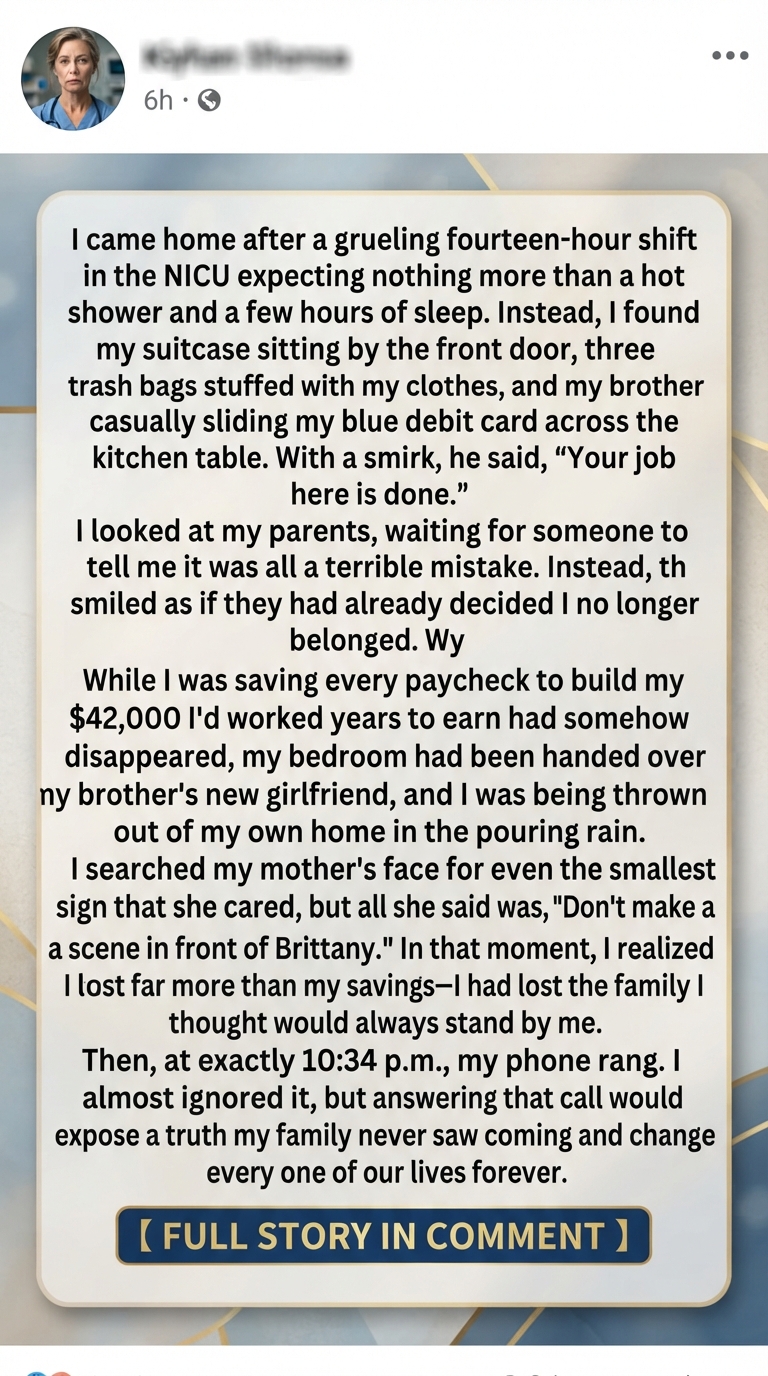
I Came Home After a Fourteen-Hour NICU Shift to Find My Suitcase by the Door… Then One Phone Call Changed Everything
Fourteen hours in the NICU leaves you emotionally empty.
That day, we’d fought to save a premature baby who weighed barely two pounds.
Another family had received heartbreaking news.
By the time I finally clocked out, all I wanted was a shower, silence, and my own bed.
Rain hammered my windshield as I pulled into my parents’ driveway.
I still lived with them at twenty-nine.
Not because I couldn’t afford to move.
Because I was saving.
Every overtime shift.
Every holiday worked.
Every weekend sacrificed.
For five years, I’d been building a down payment for my own home.
Forty-two thousand dollars sat in my savings account.
Or so I believed.
I unlocked the front door.
Immediately, something felt wrong.
My suitcase sat beside the entryway.
Three black trash bags stuffed with clothes leaned against the wall.
Confused, I walked farther inside.
My younger brother, Kyle, sat comfortably at the kitchen table beside his girlfriend, Brittany.
He slowly slid my blue debit card across the table.
With a grin, he said,
“Your job here is done.”
I laughed nervously.
“What is this?”
No one laughed back.
I looked toward my parents.
My mother folded her arms.
My father wouldn’t meet my eyes.
“Kyle and Brittany need the bedroom,” my mother said.
“So…”
“…it’s time for you to move on.”
I blinked.
“What?”
“You’ve lived here long enough.”
“I work fourteen-hour shifts.”
“I’ve been saving for a house.”
My brother shrugged.
“Not anymore.”
A chill ran through me.
“What does that mean?”
He tapped the debit card.
“I checked the balance.”
“There isn’t one.”
My stomach dropped.
“What?”
I grabbed my phone.
Opened my banking app.
Available balance:
**$18.47**
I stared at the screen.
There had to be a mistake.
My savings account…
Gone.
Forty-two thousand dollars.
Every dollar I’d earned.
Every overtime shift.
Every missed birthday.
Gone.
I looked at my parents.
“What happened?”
My father finally spoke.
“We borrowed it.”
I couldn’t process the words.
“You…”
“…borrowed my savings?”
My mother answered as though explaining something obvious.
“Kyle wanted to open a business.”
“He needed help.”
I looked at my brother.
“What business?”
He smiled proudly.
“A custom car shop.”
“You’ve never repaired a car in your life.”
“I’m learning.”
I turned back to my parents.
“You took money from my account.”
My mother sighed dramatically.
“You’re family.”
“It’s all staying in the family.”
“You forged my authorization?”
“We had access because you asked us to help when you worked night shifts.”
Years earlier, I’d added my mother to the account so she could transfer money if I was ever hospitalized after a serious car accident I’d been in.
I had trusted her.
She had used that trust to empty my savings.
“I’ll call the bank.”
“You wouldn’t.”
“I absolutely would.”
My mother’s expression hardened.
“Don’t make a scene in front of Brittany.”
That sentence hurt more than losing the money.
Not,
*”We’re sorry.”*
Not,
*”We’ll fix this.”*
Just…
Don’t embarrass the guests.
I quietly picked up the trash bags.
Carried them outside.
Loaded everything into my car.
The rain soaked through my scrubs.
I had nowhere to go.
At exactly **10:34 p.m.**, my phone rang.
I almost ignored it.
Instead, I answered.
“This is Rebecca.”
A calm voice replied,
“Ms. Morgan?”
“This is Daniel from First Community Bank’s fraud department.”
My heart skipped.
“We’ve been trying to reach you.”
“Several large withdrawals from your savings account triggered an internal review.”
I gripped the phone tighter.
“I didn’t authorize them.”
There was a brief silence.
“I was hoping you wouldn’t say that.”
He explained that because the withdrawals were unusually large and inconsistent with my normal banking activity, the bank had flagged them.
They had attempted to verify the transactions several times.
The contact information on the account had recently been changed.
Without my knowledge.
By someone using my mother’s authorized access.
When they couldn’t reach me, the fraud team froze the remaining accounts and began an investigation.
“I need you to come in tomorrow morning.”
“I’ll be there.”
The next day, I arrived carrying every document I had.
The fraud investigator listened carefully.
Because the transfers exceeded my mother’s authority under the account agreement and had been made without my informed consent, the bank referred the matter to law enforcement while beginning its own review.
The investigation lasted weeks.
Security footage.
Electronic records.
Authorization logs.
Everything pointed to the same conclusion.
My parents had transferred nearly every dollar into accounts controlled by Kyle.
Most of it had already been spent.
The police interviewed everyone involved.
Kyle insisted,
“My parents said it was a gift.”
My parents claimed,
“We thought she’d understand.”
The detective looked at them and quietly replied,
“Understanding isn’t the same thing as permission.”
Eventually, the bank restored a substantial portion of my losses because several transfers had violated its own verification procedures.
The remaining amount became part of a court-ordered restitution agreement after the criminal case was resolved.
It wasn’t fast.
It wasn’t easy.
But justice arrived one step at a time.
While the investigation unfolded, something unexpected happened.
The director of nursing at my hospital called me into her office.
“I heard what happened.”
I looked surprised.
One of my coworkers had quietly organized a temporary place for me to stay.
Another nurse offered her guest room.
The hospital’s employee assistance program connected me with legal and financial counseling.
I had spent years believing family was defined by blood.
My coworkers taught me otherwise.
Six months later, I used the restored savings—and a first-time homebuyer program—to purchase a modest townhouse.
It wasn’t the large dream home I’d once imagined.
But every payment, every wall, every key belonged to me.
No one else.
My parents tried to contact me repeatedly.
Letters.
Emails.
Voicemails.
For a long time, I wasn’t ready.
Eventually, I agreed to meet them.
Not because everything was forgiven.
Because I needed closure.
My mother cried almost the entire conversation.
“We thought you’d always forgive us.”
I looked at her quietly.
“I probably would have.”
“If you’d asked.”
My father lowered his head.
“We convinced ourselves we were helping both of our children.”
“No.”
“You were helping one child…”
“…by sacrificing the other.”
Neither of them argued.
Because they couldn’t.
Kyle’s business failed within a year.
Not because I reported the theft.
Because shortcuts and borrowed money cannot replace experience or responsibility.
Years later, he wrote me a letter.
For the first time in his life, he accepted responsibility without excuses.
He repaid every remaining dollar he owed, little by little, over several years.
We are civil today.
Careful.
Respectful.
Trust returns much more slowly than money.
One evening, after finishing another long NICU shift, I unlocked the front door of my own home.
I set down my keys.
Hung up my jacket.
And stood for a moment in the peaceful silence.
No one could throw me out.
No one could empty my account.
No one could decide whether I belonged.
Sometimes people ask whether losing my family was worth finding my independence.
I tell them I didn’t lose my family that rainy night.
I lost the illusion that love gives people the right to take what you’ve earned.
Real family doesn’t demand your future as the price of someone else’s comfort.
Real family protects what you’ve built, celebrates your success, and never mistakes your kindness for permission.
It took losing one home to finally build another—one founded not on obligation, but on respect.
